Crochet Dumpling Amigurumi Pattern
This crochet dumpling amigurumi has a soft half-moon shape, a…

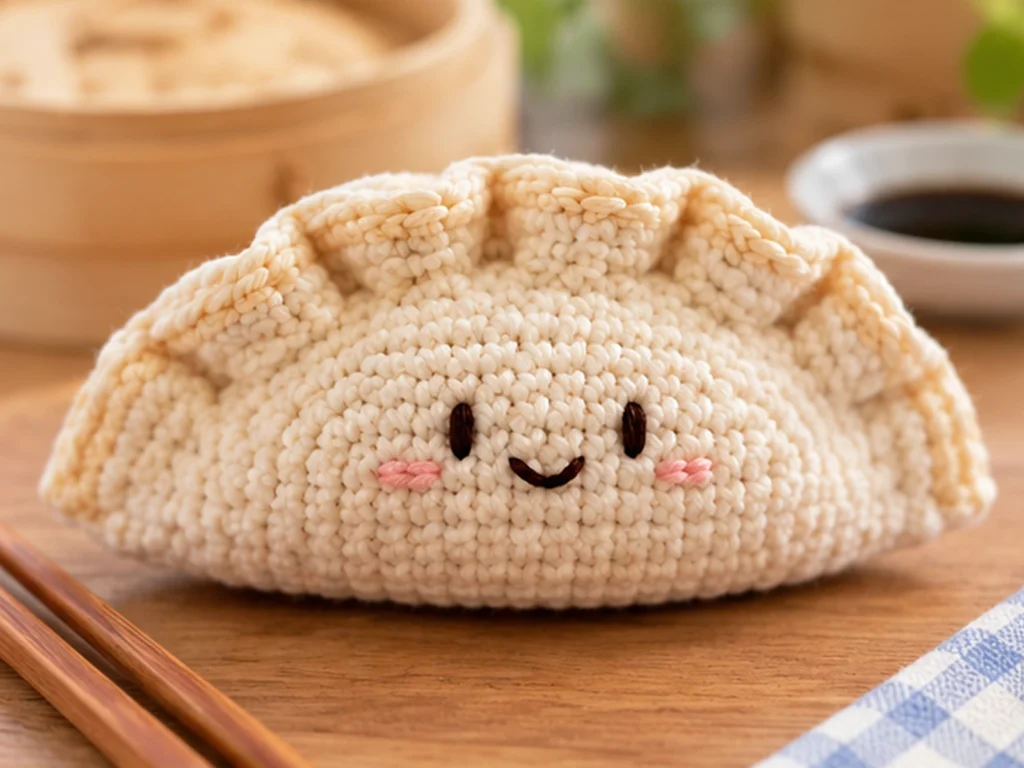
This crochet dumpling amigurumi has a soft half-moon shape, a folded wrapper edge, and a tiny embroidered face. The design starts with one circular crochet shell and transforms into a plump dumpling through folding, stitching, stuffing, and a few simple finishing details.
The pattern uses a one-piece main construction, so there are no separate crocheted body parts to assemble. The circular shell is folded in half, shaped, stuffed, and finished with hand-stitched pleats.
This pattern has been mathematically reviewed and constructionally checked, but it has not been physically crocheted and tested yet. Final size and shaping can vary with yarn, hook size, tension, stuffing, and individual crochet technique.
Project Overview
What You’ll Make
You’ll create a small stuffed crochet dumpling with:
- A rounded half-moon silhouette
- A folded wrapper edge
- Hand-stitched pleat details
- A simple embroidered face
- A soft stuffed center
The drafted design targets approximately 4–4.5 inches wide and 2–2.5 inches high, but the finished size is approximate rather than guaranteed.
Project Details
| Detail | Pattern |
|---|---|
| Project type | Food amigurumi |
| Yarn | Medium/worsted weight (#4) |
| Hook | 3.25 mm |
| Main color | Warm cream or dumpling-wrapper beige |
| Accent color | Light tan or golden beige |
| Stuffing | Polyester fiberfill |
| Face | Embroidery |
| Construction | One circular shell folded into a dumpling |
| Skill level | Not formally assigned |
| Finished size | Approximately 4–4.5 inches wide |
Your finished dumpling may turn out slightly larger or smaller depending on your tension, yarn, stuffing, and finishing technique.
Materials & Tools
You will need:
- Medium/worsted-weight yarn in a warm cream or beige shade
- 3.25 mm crochet hook
- Polyester fiberfill
- Yarn needle
- Stitch marker
- Black embroidery thread
- Optional pink embroidery thread for tiny blush details
No safety eyes are used for this design because the face is embroidered directly onto the finished dumpling.
Abbreviations
This pattern uses standard US crochet terminology.
- MR — magic ring
- sc — single crochet
- inc — increase; work 2 sc in the same stitch
- BLO — back loop only
- FO — fasten off
Before You Start
The main shell is worked in continuous rounds.
Use a stitch marker to keep track of the beginning of each round. This becomes especially helpful as the stitch count increases.
The finished crochet piece begins as a flat circular shell. After the crochet portion is complete, the shell is folded in half to create the dumpling’s half-moon shape.
The final shaping depends partly on stuffing. Add fiberfill gradually rather than packing it firmly into the piece.
The face is embroidered after the dumpling has been completely assembled.
Crochet Dumpling Pattern
Main Dumpling Shell
Work the shell in the main wrapper color.
Round 1
6 sc in MR. (6)
Round 2
6 inc. (12)
Round 3
(sc, inc) × 6. (18)
Round 4
(2 sc, inc) × 6. (24)
Round 5
(3 sc, inc) × 6. (30)
Round 6
(4 sc, inc) × 6. (36)
Round 7
(5 sc, inc) × 6. (42)
Round 8
(6 sc, inc) × 6. (48)
Round 9
(7 sc, inc) × 6. (54)
Round 10
(8 sc, inc) × 6. (60)
Round 11
60 sc BLO. (60)
Fasten off, leaving a long yarn tail for assembly.
Shape the Dumpling
Once the crochet shell is finished, the circular piece becomes the base of the dumpling.
Step 1: Mark the Fold
Lay the shell flat.
Mark two opposite points on the final round. These points define the two ends of the fold.
Step 2: Fold the Shell
Fold the circle in half so the marked points meet.
The result should resemble a soft half-moon.
The folded straight edge becomes the top wrapper edge, while the rounded outside edge becomes the curved seam of the dumpling.
Step 3: Stitch the Curved Edge
Thread the long yarn tail onto your yarn needle.
Whip stitch the two layers together along the curved outer edge.
Leave a small section open so you can add the stuffing.
Stuff the Dumpling
Add polyester fiberfill through the remaining opening.
Work slowly, adding a little stuffing at a time.
Aim for a shape that is:
- Rounded through the center
- Soft rather than rigid
- Slightly compressed along the wrapper edge
- Full enough to hold its shape without stretching the stitches
Avoid overstuffing because too much pressure can distort the folded wrapper edge.
Close the Dumpling
Once you are happy with the shape, continue whip stitching the remaining section of the curved edge.
Secure the yarn and weave in the end neatly.
You should now have a complete stuffed dumpling shape with a folded straight edge along the top.
Add the Pleated Wrapper Edge
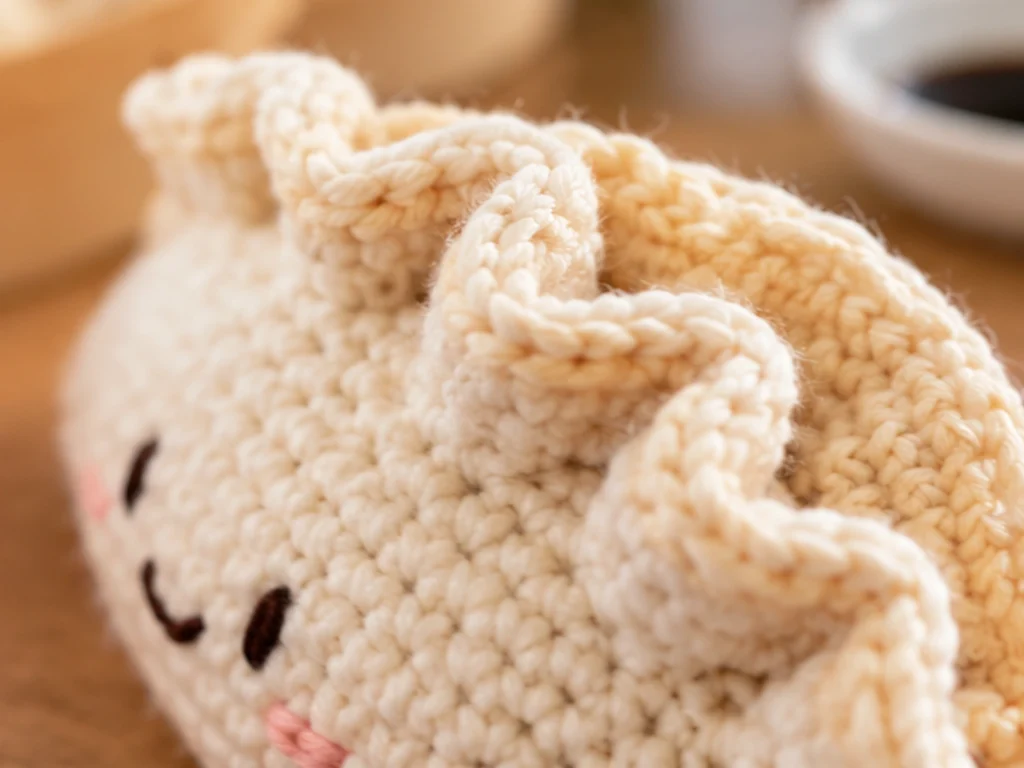
The pleated edge gives the finished project its recognizable dumpling appearance.
Using matching or light tan yarn and a yarn needle:
- Look along the folded top edge.
- Choose approximately 5–6 evenly spaced points.
- At each point, make a small stitch through the front and back layers.
- Pull gently to create a small fold.
- Repeat across the edge.
- Compare the pleats visually and adjust them so the edge looks balanced.
Do not pull the tacking stitches too tightly. The goal is to create soft, visible folds rather than a heavily gathered edge.
Add the Embroidered Face
Once the dumpling has been shaped and closed, add the face to the front half.
Eyes
Use black embroidery thread to create two small vertical eyes.
Place them symmetrically by comparing both sides visually before making the stitches permanent.
Mouth
Add a small curved smile underneath the eyes.
Keep the mouth centered between the eyes so the face remains balanced on the curved surface.
Optional Blush
For a softer expression, add two tiny pink embroidered accents on either side of the face.
Because the facial features are embroidered, you can make subtle changes to the expression without changing the crochet construction.

Troubleshooting
My dumpling looks too flat
The piece may need a little more stuffing.
Add small amounts of fiberfill gradually and reshape the center with your fingers. Avoid filling it so firmly that the wrapper edge loses its soft profile.
My dumpling looks too round
Overstuffing can push the folded shape outward.
Remove a small amount of stuffing if needed, then reshape the center before finishing the final opening.
My wrapper edge looks uneven
Check the fold before adding the pleats.
Make sure the two sides of the shell are aligned first. Then add the pleat tacks gradually and compare one side with the other as you work.
My pleats are too tight
Loosen the tacking stitches and allow the folds to remain slightly relaxed.
The wrapper edge should look folded and gathered without being heavily cinched.
The face looks off-center
Identify the center of the front half visually before embroidering.
Place the eyes first, compare both sides, and then add the mouth.
My stitch count is off
Stop and return to the last round where your stitch count was correct.
Check each increase carefully. The increases in this pattern are distributed evenly around the circle, so a missed or extra stitch can affect the shape of later rounds.
Customization Ideas
Change the Wrapper Color
Try soft neutral shades such as cream, beige, light tan, or warm golden tones.
A contrasting accent can also make the folded edge stand out.
Create a Different Expression
The crochet construction stays the same when you change the embroidery.
You can experiment with:
- Different eye shapes
- A wider smile
- A smaller mouth
- Tiny blush marks
- A sleepy expression
Experiment With Yarn
Using a different yarn or hook can change the final size and texture.
A larger yarn and appropriately matched hook may produce a larger dumpling, while a smaller yarn may create a smaller version. These variations have not been physically tested with this design, so the resulting proportions should be treated as experimental.
Change the Pleat Style
You can vary the number and depth of the hand-stitched pleats to create a flatter or more gathered-looking wrapper edge.
Keep the placement visually balanced across the top.
Care
Keep the finished crochet dumpling clean and dry, and handle the embroidered details gently.
Because the pattern has not been physically tested with different yarns or care methods, follow the care instructions recommended for the specific yarn you use.
Frequently Asked Questions
What yarn works for this crochet dumpling?
The drafted design uses medium/worsted-weight (#4) yarn. A different yarn may be substituted, but it can change the finished size, texture, and stuffing requirements.
What hook size is used?
The drafted design uses a 3.25 mm crochet hook.
Does this pattern use safety eyes?
No. The face is embroidered with thread.
How do I get the dumpling shape?
The project begins as a circular crochet shell. The shell is folded in half to create the half-moon silhouette, then stuffed and stitched closed.
Can I make the dumpling larger?
You can experiment with yarn and hook changes, but the exact results have not been physically tested with this design. Different materials can affect both size and proportions.
Can I turn this into a keychain?
This pattern does not include a tested keychain attachment or reinforced hanging point. A keychain version would require a separately validated attachment method.
Has this crochet dumpling pattern been physically tested?
Not yet. The pattern has been mathematically reviewed and constructionally checked, but it has not been physically crocheted and tested.
More Crochet Food & Amigurumi
A crochet dumpling can be a fun starting point for building a collection of small food-inspired amigurumi. Related projects can also be explored once they are available on Tiny Yarn Tales.

Final Thoughts
This crochet dumpling is built around a simple transformation: a flat circular shell becomes a soft, rounded dumpling through folding, stuffing, stitching, and finishing.
The curved seam creates the stuffed form, while the pleated wrapper edge and embroidered face give the project its character.
Since the pattern has not yet been physically crocheted and tested, treat the approximate size and final proportions as a design target rather than a guarantee. Your yarn, tension, stuffing, and finishing technique will all influence the finished piece.